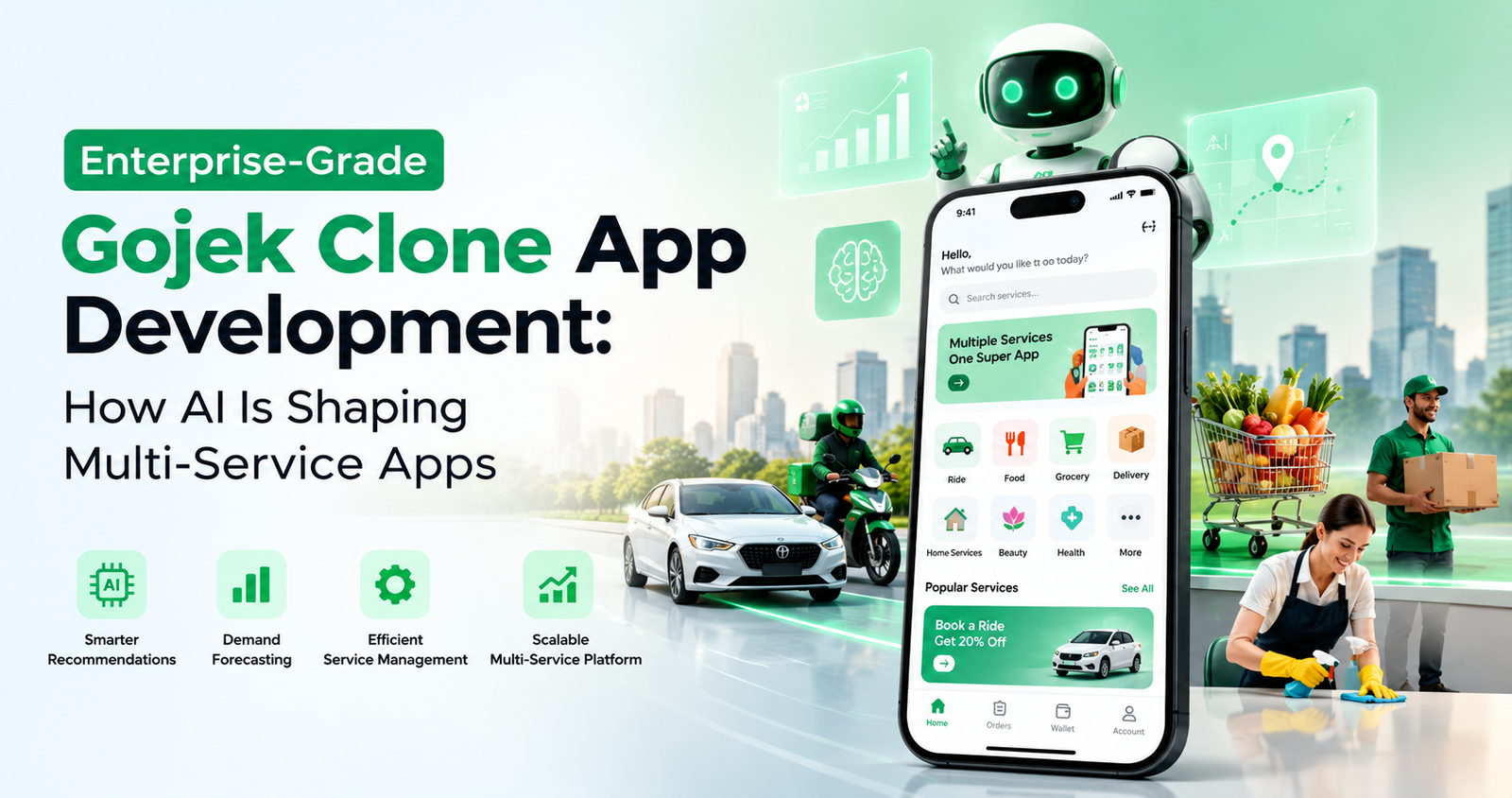
Enterprise-Grade Gojek Clone App Development: How AI Is Shaping Multi-Service Apps
Introduction
Customer expectations are changing as people look for faster, more convenient ways to access everyday services. From booking rides and ordering food to purchasing groceries and hiring home service professionals, users increasingly prefer platforms that bring multiple services together in one place. This shift is creating new opportunities for startups, entrepreneurs, and established businesses to enter the on-demand service market.
An enterprise-grade Gojek Clone App helps businesses build a multi-service platform under their own brand. With artificial intelligence (AI) becoming more widely used in digital platforms, businesses can also explore smarter recommendations, personalized experiences, demand forecasting, and improved service management.
AI is changing how businesses approach super app development by helping them understand customer behavior and make better operational decisions. Instead of managing separate applications for different services, businesses can create a unified platform that connects customers, service providers, delivery partners, and administrators.
For companies planning to launch or expand an on-demand business, combining a flexible multi-service platform with practical AI capabilities can support customer retention, operational efficiency, and long-term business growth.
What Is a Gojek Clone App?
A Gojek Clone App is a customizable, multi-service application inspired by the business model of Gojek. It enables businesses to offer several on-demand services through a single branded platform rather than requiring customers to use separate applications for each service.
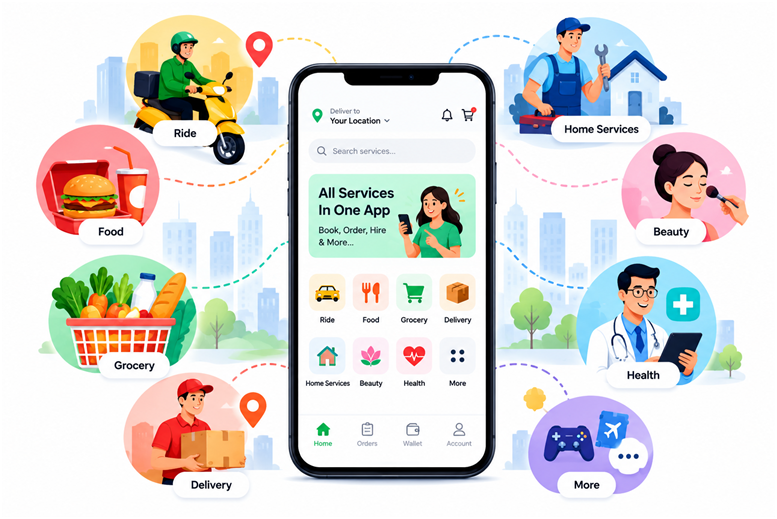
Depending on business requirements, the platform can support ride-hailing, food delivery, grocery delivery, courier services, home maintenance, beauty services, and other local offerings.
A typical platform includes a customer application, service provider or partner application, delivery or driver application where required, and an administrative dashboard. These components help users discover services, place orders, track requests, make payments, and manage their activities.
Businesses can select the services that match their target audience and expand their offerings as demand increases. For example, a startup could initially focus on taxi bookings and later introduce food delivery or grocery shopping.
A Gojek Clone Script provides a starting point for launching this type of platform with customizable features and branding. Businesses can adapt the available functionality to their operational requirements instead of building every standard feature from the ground up.
The main objective is to create a convenient digital ecosystem where customers can access multiple services while businesses manage different service categories through a unified platform.
How AI Is Shaping Multi-Service Apps
AI is becoming an important part of modern on-demand platforms. Its value comes from using available data to improve customer experiences, support business decisions, and reduce avoidable operational inefficiencies.
Here are several practical ways AI can improve a multi-service application.
1. Personalized Service Recommendations
Customers may use a multi-service app for different needs throughout the week. AI can analyze relevant usage patterns, previous orders, location preferences, and search activity to recommend services that may interest individual users.
Personalized recommendations can make service discovery easier and help businesses promote relevant offerings. However, recommendations should remain useful rather than intrusive, and customers should have appropriate control over their data and preferences.
2. Smarter Demand Forecasting
Demand can change according to location, weather, holidays, local events, and time of day. AI-based forecasting tools can analyze historical activity and available real-time information to estimate when particular services may experience higher demand.
A ride-hailing business might anticipate increased bookings during peak commuting hours. A grocery delivery app operator could prepare for greater order volumes before major holidays.
These insights can help businesses plan partner availability, coordinate delivery operations, and manage service coverage more effectively.
Forecasts are not guarantees, so businesses should combine AI recommendations with local knowledge and actual operating conditions.
3. Improved Matching and Dispatch
Matching customers with suitable service providers is essential for on-demand operations. AI-assisted matching can consider factors such as location, availability, estimated arrival time, service category, and provider suitability.
These capabilities can improve assignment decisions and reduce unnecessary delays. Businesses should also establish clear rules for fairness, provider preferences, and situations in which automated recommendations need human review.
4. AI-Powered Customer Support
Customers often need assistance with bookings, cancellations, refunds, delivery updates, and account questions. AI-powered chatbots can respond to common queries, provide order information, and guide users through standard support processes.
This can help businesses handle routine requests without requiring a support agent for every interaction.
More complicated matters, including disputed payments, safety concerns, and unusual service failures, should have a clear escalation path to a human representative. This balance helps maintain service quality while improving support efficiency.
5. Fraud Detection and Risk Monitoring
Multi-service platforms handle customer accounts, payments, bookings, and partner transactions. AI can help identify unusual activity, such as suspicious booking patterns, repeated payment failures, or potentially fraudulent transactions.
Risk detection systems can flag activity for further review and help businesses investigate issues earlier.
However, automated alerts should not be treated as proof of wrongdoing. Businesses need appropriate verification procedures, privacy safeguards, and review mechanisms to avoid incorrectly restricting legitimate customers or service providers.
Key Features of an AI-Enabled Multi-Service Platform
When businesses plan to build a super app, they should prioritize features that solve real customer and operational problems. AI should improve the experience rather than simply serve as a marketing label.
Important capabilities include:
Unified Service Booking
Customers should be able to browse available categories, compare service options, schedule bookings where supported, and manage requests from one application.
Real-Time Tracking and Notifications
Live tracking, booking updates, estimated arrival information, and timely notifications help customers understand the status of their requests. These features are particularly valuable for transportation, courier, and delivery services.
Multiple Payment Options
Supporting suitable digital payment methods and transaction records can make payments more convenient. Businesses should select payment options according to their operating markets and applicable regulations.
Intelligent Search and Discovery
AI-assisted search can help users find relevant services through natural-language queries, preferences, and contextual recommendations. Clear filters should remain available for customers who prefer direct control over their search.
Partner and Service Management
Service providers need practical tools to manage availability, bookings, service areas, earnings information, and customer requests. Administrators should be able to oversee service categories, manage partners, monitor performance, and handle complaints.
Analytics and Performance Monitoring
Business dashboards can help operators understand order volumes, cancellations, repeat usage, customer feedback, and service-level performance. AI-generated insights may highlight emerging trends, but decisions should be based on reliable data and measurable outcomes.
Business Opportunities and Use Cases
A multi-service platform can support different business models depending on the audience, service availability, and operational capabilities.
Ride-Hailing and Transportation
Taxi operators and mobility startups can use a Gojek like app to connect passengers with drivers. AI-assisted demand forecasting and driver matching may help improve availability and booking management.
Food and Grocery Delivery
Restaurants, grocery stores, and delivery businesses can offer ordering, payment, tracking, and partner management through a shared platform. Personalized recommendations can also help customers discover relevant products and restaurants.
Home and Personal Services
Businesses can connect customers with electricians, plumbers, cleaners, beauty professionals, and other service providers. Intelligent matching can help identify suitable professionals based on skills, availability, location, and customer requirements.
Courier and Local Delivery
Local businesses can coordinate document deliveries, parcels, and other permitted goods through an on-demand marketplace. Dispatch recommendations and route planning can help operators manage delivery requests more efficiently.
Multi-Category Marketplaces
Entrepreneurs can combine several complementary services to serve a specific city, region, or customer segment. For example, a local platform might start with transportation and food delivery app development before introducing home services.
This approach to multi service app development allows businesses to validate demand in selected categories before expanding into additional markets.
Why Businesses Choose an Enterprise-Grade Approach
An enterprise-grade platform needs to support more than basic booking functionality. It should help businesses manage growing service operations, maintain consistent customer experiences, and adapt to changing market requirements.
Flexibility Across Service Categories
Businesses have different operational needs. A flexible Gojek Clone App allows operators to configure service categories, booking workflows, partner requirements, and customer-facing features according to their business model.
This is useful for companies that want to launch a focused marketplace first and introduce additional services when operationally ready.
Consistent Customer Experience
A unified platform gives customers a familiar way to discover services, manage bookings, access support, and review transactions. Consistency can reduce confusion when users move between different service categories.
Better Operational Visibility
Centralized administration helps businesses monitor activity across services. Operators can identify underperforming categories, review service quality, manage partner accounts, and respond to operational issues.
AI-generated reports can supplement these insights by highlighting patterns that may otherwise be difficult to identify.
Support for Business Expansion
Businesses may need to introduce new service categories, expand into additional locations, or support different customer groups over time. An enterprise-oriented solution should provide the flexibility to accommodate these changes without forcing the business to redesign its entire operating model.
A More Structured Route to Market
Working with an experienced super app development company can help businesses define their launch scope, select relevant features, and plan future improvements.
A ready-made Gojek Clone can provide a practical starting point, while customization helps align the platform with the company’s brand, market requirements, and service processes.
Businesses should evaluate the provider’s customization capabilities, documentation, security practices, support arrangements, and ownership terms before making a decision.
How to Build a Super App Like Gojek With AI
Businesses planning to build a super app like Gojek should begin with a clear business strategy rather than trying to introduce every possible feature immediately.
First, identify the target audience and the problems the platform will solve. Research local demand, competitors, service availability, and customer expectations.
Next, select the initial service categories. Starting with a manageable group of services can make it easier to test demand, establish partner relationships, and improve daily operations.
Before finalizing the platform requirements, businesses can understand how a Gojek Clone App works and how its different components support multi-service operations.
Then, define the essential customer, provider, and administrative features. Booking management, payments, notifications, customer support, and service monitoring should receive priority before advanced AI capabilities are introduced.
After establishing reliable operational data, evaluate where AI can provide measurable value. Personalization, demand forecasting, intelligent matching, and support automation are potential starting points.
Finally, monitor performance using relevant metrics such as booking completion rates, repeat usage, cancellation rates, customer satisfaction, and service fulfillment time. Use these findings to improve the platform and decide which services or AI capabilities to introduce next.
A business seeking Gojek like app development should also consider local regulations, payment requirements, data protection, accessibility, and service-specific compliance before launching.
Conclusion
AI is creating new opportunities for businesses to improve personalization, demand planning, customer support, fraud monitoring, and service management. When applied to a well-planned multi-service platform, these capabilities can help businesses deliver more convenient experiences and make better operational decisions.
A Gojek Clone App offers startups, entrepreneurs, and established companies a customizable starting point for launching their own branded on-demand marketplace. The strongest results come from choosing services that match real customer demand, establishing reliable operating processes, and introducing AI where it delivers measurable benefits.
Partnering with an experienced clone app development company can help businesses assess their requirements, customize the right features, and plan for future expansion. A phased approach that combines customer needs, operational readiness, and responsible AI adoption provides a practical foundation for building a sustainable multi-service business.
Frequently Asked Questions
1. What is a Gojek Clone App?
A Gojek Clone App is a customizable, multi-service application that allows businesses to offer services such as taxi booking, food delivery, grocery shopping, courier services, and home maintenance through one branded platform.
2. How does AI improve a multi-service app?
AI can support personalized recommendations, demand forecasting, service provider matching, customer support automation, and suspicious activity detection. Its effectiveness depends on data quality, business requirements, and appropriate human oversight.
3. Which businesses can use a Gojek Clone Script?
Startups, entrepreneurs, taxi operators, delivery businesses, local service marketplaces, and established enterprises can use a Gojek Clone Script as a starting point for launching a customizable on-demand platform.
4. Can businesses add multiple services to a Gojek-like platform?
Yes. Businesses can configure a platform to support multiple categories, depending on the solution’s capabilities. They can launch with selected services and expand as customer demand, partner availability, and operational readiness increase.
5. What should businesses consider when choosing a super app development company?
Businesses should assess customization options, supported service categories, AI capabilities, security practices, scalability, integration requirements, technical support, documentation, and source code ownership terms. The selected provider should understand the business model and its target market.