Inside a Modern Brick Factory: How a Brick Is Actually Made
The first thing that surprises people who visit a modern brick plant is how quiet it is.
No rows of workers slapping clay into wooden moulds. No open fire. Mostly it is a long shed, a conveyor, a machine that hums, and two or three people watching gauges.
Here is what happens between the clay pit and the pallet on your site.
Stage one: the clay, and why it is never one clay
Nobody digs up clay and uses it straight.
Different deposits behave differently. Some are too plastic and crack as they dry. Some have too much sand and never bind properly. Some carry lime nodules that expand after firing and pop chunks out of a finished brick months later.
So the plant blends. Two or three clays from different sources, mixed to a recipe that gets tested and adjusted as the deposits shift over time. Stones and lime get screened out. Water content is measured, not guessed.
This stage decides the colour of your final brick, incidentally. Iron content in the clay is what makes a red brick red.
Stage two: extrusion
The blended clay goes through a mixer, then into an extruder — essentially a large screw that compacts the material and pushes it out through a shaped die under vacuum.
Two things happen here that hand moulding cannot replicate.
The vacuum pulls out trapped air pockets, which are exactly where cracks like to start. And the pressure compacts the clay far more densely than a hand press ever could, which is where the strength comes from.
Out of the die comes a continuous column of clay in the profile of the finished product. A wire cutter slices it into equal lengths.
That cutting step is why every brick from a proper brick making plant is the same size. Not roughly the same. The same.
Stage three: drying, slowly and on purpose
Green bricks hold a lot of moisture, and you cannot rush it out.
Dry too fast and the outside shrinks while the inside is still wet, which cracks the piece. So the units go into a controlled dryer where temperature and humidity are stepped gradually over many hours, often using recovered waste heat from the kiln next door.
Sun drying still exists in traditional yards. It works, but it stops working in July.
Stage four: the kiln
This is where a modern brick factory separates itself completely from the old model.
In a traditional Bull’s Trench kiln, the fire moves and the bricks stay put — which means bricks in different positions receive very different heat. Outer rows come out soft, inner rows come out overburnt.
In a tunnel kiln, the bricks move on cars slowly through fixed temperature zones: preheat, firing, cooling. Peak firing sits around 950 to 1,050 degrees Celsius depending on the clay body. Every brick passes through exactly the same profile.
That is the entire reason machine made bricks are consistent. Not marketing. Just physics applied evenly.
Stage five: sorting, and this is where quality lives
Fired units come out and get inspected. Colour, dimensions, edge condition, ring test. Off-spec pieces get pulled.
Samples go for compressive strength and water absorption testing. Those are the figures a buyer should be asking for later.
Then the good stock gets banded onto pallets and stored by batch. Batch tracking matters more than people realise — it is what lets you order a matching top-up lot four months into a project instead of getting a slightly different shade.
Why any of this matters to a buyer
You are not buying a brick. You are buying the process that made it.
Two units can look identical on the counter and behave completely differently in a wall, because one came out of a controlled kiln and the other came from the cold edge of an open firing.
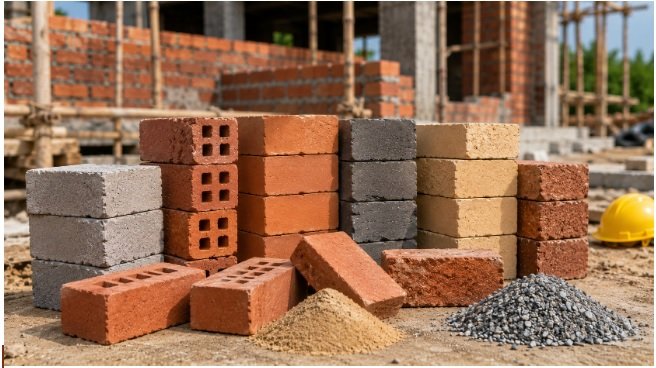
This is why it is worth knowing whether your supplier actually owns a plant. Established brick factories control clay blending, extrusion, drying, firing, and sorting under one roof. Mahaluxmi Bricks has operated its Panchkula unit since 1982, is ISO certified, and runs wirecut, jali, blocks, special shapes, and roof tiles off the same controlled process — which is what makes its output repeat from one order to the next.
If you ever get the chance, go and look
Most manufacturers will let you walk the floor if you ask.
Half an hour watching the extruder and the kiln will teach you more about why one brick costs more than another than any amount of comparing rates on the phone.
And if a supplier does not want you anywhere near the production line, that itself is worth noting.